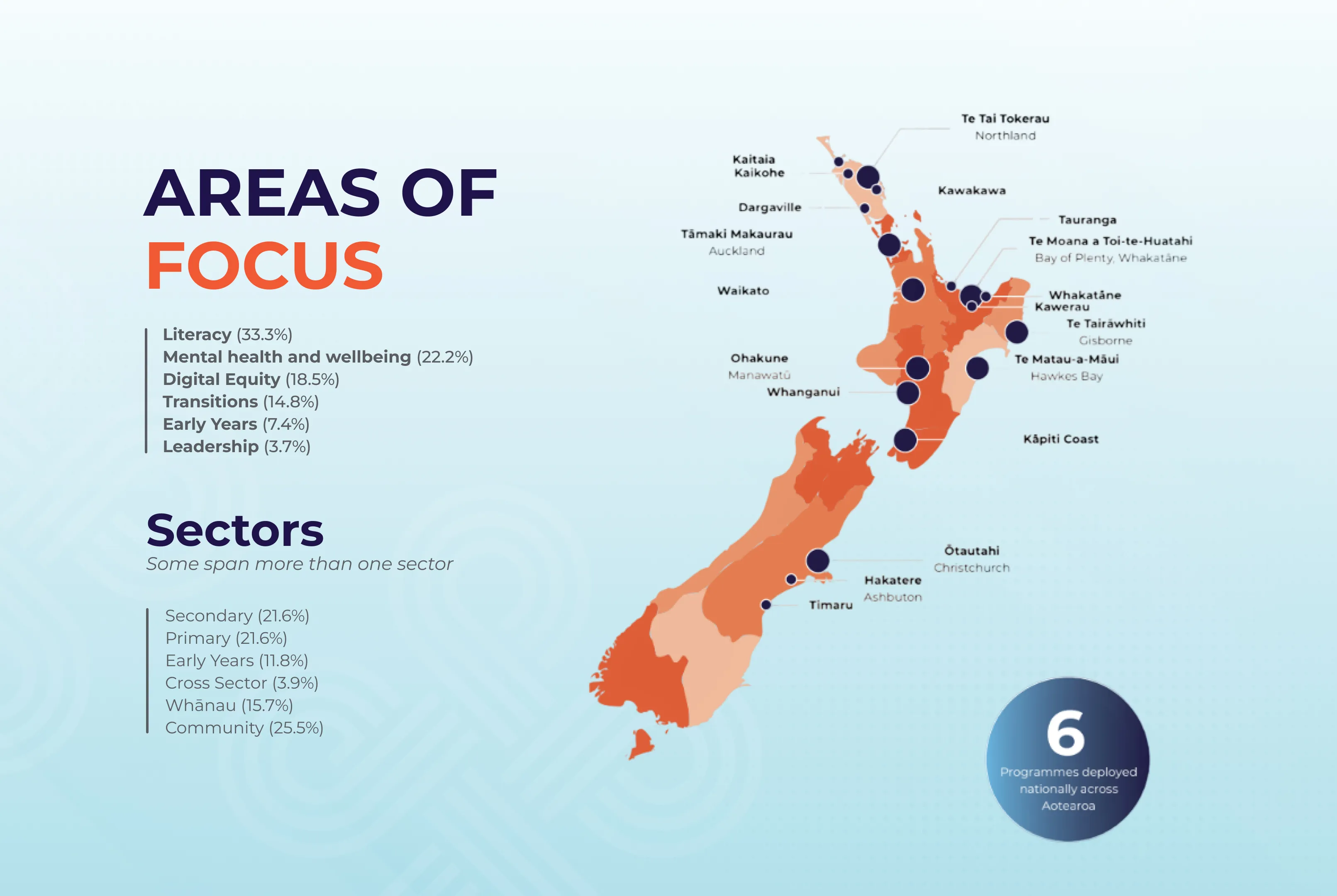
Pull up a map of Aotearoa and look at where EPIT's partners are working. Te Tai Tokerau to Ōtautahi. Tāmaki Makaurau to the West Coast. Gisborne's kura, Hawke's Bay's libraries, Bay of Plenty homes where whānau are showing up as their children's first teachers. Each pin on that map is a promise, that local insight matters, and that national collaboration multiplies impact.
This is what transformative partnerships in education look like when they leave the whiteboard and take root in communities.
The problem with traditional funding models
Most funding models are built on a simple assumption: grant money flows in, a programme runs, results are measured, credit is assigned. It's a tidy story, and it rarely survives contact with how communities actually change.
Real change in communities doesn't follow that arc. Lasting transformation is non-linear, relational, and in the best possible way, slow. Short funding cycles reward speed over depth. They push organisations to demonstrate impact before trust has even been established. And when the grant ends, the relationship ends with it.
There's another cost that's harder to quantify. When institutions arrive with a solution already shaped, communities feel it. The unspoken message, however unintended, is that local knowledge is secondary. That erodes trust, and trust, once lost in a community context, takes years to rebuild.
The pressure to attribute impact to a single funder or programme fragments what should be collective effort. Organisations working in the same rohe | region on the same challenges can end up competing rather than collaborating, not because they want to, but because the system rewards individual credit over shared contribution.
What transformative partnership actually means
A transformative partnership is a long-term, relationship-led collaboration designed with communities rather than for them, one that measures success through collective contribution, not individual attribution.
That definition has four dimensions, each of which shapes how we work.
Relationships as the foundation
The relationship comes first. The programme follows. Before any initiative is scoped, we spend time understanding a community, its people, its history, its aspirations, and the barriers it has already tried to navigate. Trust is the infrastructure that everything else is built on.
"He aha te mea nui o te ao? Māku e kī atu, he tangata, he tangata, he tangata". It translates to: "What is the most important thing in the world? I will tell you, it is people, it is people, it is people".
Wayfinding over milestones
Change rarely travels in a straight line. Our model is built around that reality, iterative, adaptive, and learning-led. Rather than locking partners into fixed deliverables, we orient by direction and shared values. When something is not working, the partnership adapts. The model is designed to hold that kind of honest reckoning.
Shared contribution
No single organisation owns the outcome of genuine systems change. We actively resist the pressure to claim credit, and we encourage our partners to do the same. Collective impact means success is shared across the full constellation of people and organisations who contributed. That's a more honest account of how change happens, and a more durable one.
Long-term commitment
Relational trust cannot be built in a 12-month funding cycle. We work across the full arc of change, present at the launch of an initiative, and through the iterations, the setbacks, and the moments of genuine breakthrough that only reveal themselves over time.
What this looks like in practice
Stand Tall Community Trust offers a clear example of what this model produces when it's given room to breathe.
In Year 1, the partnership focused on establishing presence and trust, understanding what rangatahi in the community actually needed, rather than what a programme spec assumed they needed. By Year 3, that foundation had enabled something more ambitious: entrepreneurial and digital pathways built from the ground up with community input, expanding access in ways a pre-packaged programme could not have reached.
Between those years, something deeper shifted than the activities on the ground. The relationship deepened. The learning accumulated. We were embedded, listening, and adapting alongside Stand Tall as the work evolved.
Zoom out and the same pattern repeats across the motu. From digital equity initiatives in rural schools to early years programmes supporting whānau as first teachers, the partnerships in our network span sector, geography, and community context. What they share is the same commitment: show up for the long haul, share what is learned, and understand that impact belongs to the collective. That story is told in full in our 2024–25 Impact Report, Constellations of Change.
From partnerships to systems
Partnerships do not exist in isolation. When they are built on genuine trust and shared learning, they naturally evolve into something larger, networks of practice where knowledge flows freely, where what works in one rohe can inform what is tried in another.
This is where our Communities of Practice become the connective tissue of the work. These are learning engines, spaces where partners across the motu surface real challenges, test new approaches, and build the kind of collective intelligence that no single organisation could generate alone.
The path from partnership to systems change runs through shared learning. Connect the partnerships. Sustain the learning. Change the conditions. That is the arc we are working across.
The shift we are driving
Transformation does not come from funding alone. It comes from relationships that evolve, from the moment a community is heard, through the years of iterative work, to the point where something in the system genuinely shifts.
Every contribution matters. Small, connected efforts create constellations of change. When those constellations are supported by sustained partnership, shared learning, and a genuine commitment to equity, the whole becomes greater than the sum of its parts.
That is the shift we are working toward. A steady, collective movement, rooted in community, oriented by values, and sustained across time.
A kōrero worth having
The Education Partnerships & Innovation Trust partners with those who share a belief that communities hold the knowledge, that equity takes time, and that the most powerful outcomes belong to no single person or organisation.
What's behind it is a relationship, one that starts with genuine alignment and grows from there.
To see the full picture of where we're working and who we're working with, explore the 2024–25 Impact Report. And when you're ready to talk, we're here.
Start the conversation